
This cell adds /home/docs/checkouts/readthedocs.org/user_builds/wsu-phys-581-computation/checkouts/latest/src to your path, and contains some definitions for equations and some CSS for styling the notebook. If things look a bit strange, please try the following:
- Choose "Trust Notebook" from the "File" menu.
- Re-execute this cell.
- Reload the notebook.
Sequence Acceleration Techniques#
As a sample problem, consider accurately computing the Riemann zeta function \(\zeta(s)\) for values of \(s\) close to \(s\approx 1\):
Do It!
Spend a bit of time trying to implement this so you get an idea of how slowly the series converges before continuing. Try to estimate how many terms you need to achieve a specified tolerance. You did remember to sum from smallest to largest, didn’t you?
Estimate for convergence.
For real \(s\), the terms are monotonically decreasing, so we can bound the truncation error with integrals. (Draw a picture if needed to convince yourself.)
Simply put, the error in the truncated sum can be estimated by the integral of the tail:
but we can improve the convergence by including this tail.
To achieve a tolerance of \(\epsilon\), one thus needs about
I.e., for 12 digits we need about \(N\gtrapprox 10^{12}\) terms for \(\zeta(2)\) (doable, but slow) and \(N \gtrapprox 10^{110}\) terms for \(\zeta(1.1)\) (impossible).
Using the integral-corrected formula, the one needs
I.e., for 12 digits we need about \(N\gtrapprox 7\times 10^{5}\) terms for \(\zeta(2)\), and \(N \gtrapprox 4\times 10^{10}\) terms for \(\zeta(1.1)\).
def zeta1(N, s=2):
    n = np.arange(1, N)[::-1]
    return (1/n**s).sum()

def zeta2(N, s=2):
    return zeta1(N, s=s) + 1/(s-1)/N**(s-1) + 1/2/N**s


zeta1(1000) - np.pi**2/6
np.float64(-0.0010005001666666402)
Simple Acceleration#
An obvious thing to do is to use the integral approximation to try to accelerate the convergence. The idea is that
Subtracting this should cancel the leading order terms, and we can do this integral term by term to get a correction factor:
For large \(n\), we have
Integrating, we can estimate the error to be \(\sim 1/2n^{s}\).
from sympy import var, oo
x, q = var('x, q', positive=True)
s = 1+q
n = 1/x
a_n = 1/n**s + 1/(1-s)*(1/n**(s-1) - 1/(n+1)**(s-1))
a_n.series(x, 0, 2)
---------------------------------------------------------------------------
NotImplementedError                       Traceback (most recent call last)
File ~/checkouts/readthedocs.org/user_builds/wsu-phys-581-computation/conda/latest/lib/python3.13/site-packages/sympy/core/mul.py:1980, in Mul._eval_nseries(self, x, n, logx, cdir)
   1979 for t in self.args:
-> 1980     coeff, exp = t.leadterm(x)
   1981     if not coeff.has(x):

File ~/checkouts/readthedocs.org/user_builds/wsu-phys-581-computation/conda/latest/lib/python3.13/site-packages/sympy/core/expr.py:3558, in Expr.leadterm(self, x, logx, cdir)
   3557 from sympy.functions.elementary.exponential import log
-> 3558 l = self.as_leading_term(x, logx=logx, cdir=cdir)
   3559 d = Dummy('logx')

File ~/checkouts/readthedocs.org/user_builds/wsu-phys-581-computation/conda/latest/lib/python3.13/site-packages/sympy/core/cache.py:72, in __cacheit.<locals>.func_wrapper.<locals>.wrapper(*args, **kwargs)
     71 try:
---> 72     retval = cfunc(*args, **kwargs)
     73 except TypeError as e:

File ~/checkouts/readthedocs.org/user_builds/wsu-phys-581-computation/conda/latest/lib/python3.13/site-packages/sympy/core/expr.py:3521, in Expr.as_leading_term(self, logx, cdir, *symbols)
   3520     return self
-> 3521 obj = self._eval_as_leading_term(x, logx=logx, cdir=cdir)
   3522 if obj is not None:

File ~/checkouts/readthedocs.org/user_builds/wsu-phys-581-computation/conda/latest/lib/python3.13/site-packages/sympy/core/add.py:1076, in Add._eval_as_leading_term(self, x, logx, cdir)
   1075 while res.is_Order:
-> 1076     res = old._eval_nseries(x, n=n0+incr, logx=logx, cdir=cdir).cancel().powsimp().trigsimp()
   1077     incr *= 2

File ~/checkouts/readthedocs.org/user_builds/wsu-phys-581-computation/conda/latest/lib/python3.13/site-packages/sympy/core/add.py:507, in Add._eval_nseries(self, x, n, logx, cdir)
    506 def _eval_nseries(self, x, n, logx, cdir=0):
--> 507     terms = [t.nseries(x, n=n, logx=logx, cdir=cdir) for t in self.args]
    508     return self.func(*terms)

File ~/checkouts/readthedocs.org/user_builds/wsu-phys-581-computation/conda/latest/lib/python3.13/site-packages/sympy/core/expr.py:3466, in Expr.nseries(self, x, x0, n, dir, logx, cdir)
   3465 else:
-> 3466     return self._eval_nseries(x, n=n, logx=logx, cdir=cdir)

File ~/checkouts/readthedocs.org/user_builds/wsu-phys-581-computation/conda/latest/lib/python3.13/site-packages/sympy/core/mul.py:2046, in Mul._eval_nseries(self, x, n, logx, cdir)
   2045 if res != self:
-> 2046     if (self - res).subs(x, 0) == S.Zero and n > 0:
   2047         lt = self._eval_as_leading_term(x, logx=logx, cdir=cdir)

File ~/checkouts/readthedocs.org/user_builds/wsu-phys-581-computation/conda/latest/lib/python3.13/site-packages/sympy/core/decorators.py:248, in _SympifyWrapper.make_wrapped.<locals>._func(self, other)
    247     return retval
--> 248 return func(self, other)

File ~/checkouts/readthedocs.org/user_builds/wsu-phys-581-computation/conda/latest/lib/python3.13/site-packages/sympy/core/decorators.py:118, in call_highest_priority.<locals>.priority_decorator.<locals>.binary_op_wrapper(self, other)
    117             return f(self)
--> 118 return func(self, other)

File ~/checkouts/readthedocs.org/user_builds/wsu-phys-581-computation/conda/latest/lib/python3.13/site-packages/sympy/core/expr.py:244, in Expr.__sub__(self, other)
    241 @sympify_return([('other', 'Expr')], NotImplemented)
    242 @call_highest_priority('__rsub__')
    243 def __sub__(self, other) -> Expr:
--> 244     return Add(self, -other)

File ~/checkouts/readthedocs.org/user_builds/wsu-phys-581-computation/conda/latest/lib/python3.13/site-packages/sympy/core/cache.py:72, in __cacheit.<locals>.func_wrapper.<locals>.wrapper(*args, **kwargs)
     71 try:
---> 72     retval = cfunc(*args, **kwargs)
     73 except TypeError as e:

File ~/checkouts/readthedocs.org/user_builds/wsu-phys-581-computation/conda/latest/lib/python3.13/site-packages/sympy/core/operations.py:108, in AssocOp.__new__(cls, evaluate, _sympify, *args)
    106     return args[0]
--> 108 c_part, nc_part, order_symbols = cls.flatten(args)
    109 is_commutative = not nc_part

File ~/checkouts/readthedocs.org/user_builds/wsu-phys-581-computation/conda/latest/lib/python3.13/site-packages/sympy/core/add.py:382, in Add.flatten(cls, seq)
    380 for t in newseq:
    381     # x + O(x) -> O(x)
--> 382     if not any(o.contains(t) for o in order_factors):
    383         newseq2.append(t)

File ~/checkouts/readthedocs.org/user_builds/wsu-phys-581-computation/conda/latest/lib/python3.13/site-packages/sympy/core/add.py:382, in <genexpr>(.0)
    380 for t in newseq:
    381     # x + O(x) -> O(x)
--> 382     if not any(o.contains(t) for o in order_factors):
    383         newseq2.append(t)

File ~/checkouts/readthedocs.org/user_builds/wsu-phys-581-computation/conda/latest/lib/python3.13/site-packages/sympy/core/cache.py:72, in __cacheit.<locals>.func_wrapper.<locals>.wrapper(*args, **kwargs)
     71 try:
---> 72     retval = cfunc(*args, **kwargs)
     73 except TypeError as e:

File ~/checkouts/readthedocs.org/user_builds/wsu-phys-581-computation/conda/latest/lib/python3.13/site-packages/sympy/series/order.py:453, in Order.contains(self, expr)
    452 obj = self.func(expr, *self.args[1:])
--> 453 return self.contains(obj)

File ~/checkouts/readthedocs.org/user_builds/wsu-phys-581-computation/conda/latest/lib/python3.13/site-packages/sympy/core/cache.py:72, in __cacheit.<locals>.func_wrapper.<locals>.wrapper(*args, **kwargs)
     71 try:
---> 72     retval = cfunc(*args, **kwargs)
     73 except TypeError as e:

File ~/checkouts/readthedocs.org/user_builds/wsu-phys-581-computation/conda/latest/lib/python3.13/site-packages/sympy/series/order.py:428, in Order.contains(self, expr)
    427 from sympy.series.limits import Limit
--> 428 l = Limit(ratio, s, point).doit(heuristics=False)
    429 if not isinstance(l, Limit):

File ~/checkouts/readthedocs.org/user_builds/wsu-phys-581-computation/conda/latest/lib/python3.13/site-packages/sympy/series/limits.py:372, in Limit.doit(self, **hints)
    371         else:
--> 372             raise NotImplementedError("Not sure of sign of %s" % ex)
    374 # gruntz fails on factorials but works with the gamma function
    375 # If no factorial term is present, e should remain unchanged.
    376 # factorial is defined to be zero for negative inputs (which
    377 # differs from gamma) so only rewrite for non-negative z0.

NotImplementedError: Not sure of sign of 2 - q

During handling of the above exception, another exception occurred:

NotImplementedError                       Traceback (most recent call last)
Cell In[3], line 6
      4 n = 1/x
      5 a_n = 1/n**s + 1/(1-s)*(1/n**(s-1) - 1/(n+1)**(s-1))
----> 6 a_n.series(x, 0, 2)

File ~/checkouts/readthedocs.org/user_builds/wsu-phys-581-computation/conda/latest/lib/python3.13/site-packages/sympy/core/expr.py:3092, in Expr.series(self, x, x0, n, dir, logx, cdir)
   3090 from sympy.series.order import Order
   3091 if n is not None:  # nseries handling
-> 3092     s1 = self._eval_nseries(x, n=n, logx=logx, cdir=cdir)
   3093     o = s1.getO() or S.Zero
   3094     if o:
   3095         # make sure the requested order is returned

File ~/checkouts/readthedocs.org/user_builds/wsu-phys-581-computation/conda/latest/lib/python3.13/site-packages/sympy/core/add.py:507, in Add._eval_nseries(self, x, n, logx, cdir)
    506 def _eval_nseries(self, x, n, logx, cdir=0):
--> 507     terms = [t.nseries(x, n=n, logx=logx, cdir=cdir) for t in self.args]
    508     return self.func(*terms)

File ~/checkouts/readthedocs.org/user_builds/wsu-phys-581-computation/conda/latest/lib/python3.13/site-packages/sympy/core/expr.py:3466, in Expr.nseries(self, x, x0, n, dir, logx, cdir)
   3464     return self.series(x, x0, n, dir, cdir=cdir)
   3465 else:
-> 3466     return self._eval_nseries(x, n=n, logx=logx, cdir=cdir)

File ~/checkouts/readthedocs.org/user_builds/wsu-phys-581-computation/conda/latest/lib/python3.13/site-packages/sympy/core/mul.py:2004, in Mul._eval_nseries(self, x, n, logx, cdir)
   2002 if n0.is_nonnegative:
   2003     n0 = S.Zero
-> 2004 facs = [t.nseries(x, n=ceiling(n-n0), logx=logx, cdir=cdir) for t in self.args]
   2005 from sympy.simplify.powsimp import powsimp
   2006 res = powsimp(self.func(*facs).expand(), combine='exp', deep=True)

File ~/checkouts/readthedocs.org/user_builds/wsu-phys-581-computation/conda/latest/lib/python3.13/site-packages/sympy/core/expr.py:3466, in Expr.nseries(self, x, x0, n, dir, logx, cdir)
   3464     return self.series(x, x0, n, dir, cdir=cdir)
   3465 else:
-> 3466     return self._eval_nseries(x, n=n, logx=logx, cdir=cdir)

File ~/checkouts/readthedocs.org/user_builds/wsu-phys-581-computation/conda/latest/lib/python3.13/site-packages/sympy/core/add.py:507, in Add._eval_nseries(self, x, n, logx, cdir)
    506 def _eval_nseries(self, x, n, logx, cdir=0):
--> 507     terms = [t.nseries(x, n=n, logx=logx, cdir=cdir) for t in self.args]
    508     return self.func(*terms)

File ~/checkouts/readthedocs.org/user_builds/wsu-phys-581-computation/conda/latest/lib/python3.13/site-packages/sympy/core/expr.py:3466, in Expr.nseries(self, x, x0, n, dir, logx, cdir)
   3464     return self.series(x, x0, n, dir, cdir=cdir)
   3465 else:
-> 3466     return self._eval_nseries(x, n=n, logx=logx, cdir=cdir)

File ~/checkouts/readthedocs.org/user_builds/wsu-phys-581-computation/conda/latest/lib/python3.13/site-packages/sympy/core/mul.py:2046, in Mul._eval_nseries(self, x, n, logx, cdir)
   2043         return res
   2045 if res != self:
-> 2046     if (self - res).subs(x, 0) == S.Zero and n > 0:
   2047         lt = self._eval_as_leading_term(x, logx=logx, cdir=cdir)
   2048         if lt == S.Zero:

File ~/checkouts/readthedocs.org/user_builds/wsu-phys-581-computation/conda/latest/lib/python3.13/site-packages/sympy/core/decorators.py:248, in _SympifyWrapper.make_wrapped.<locals>._func(self, other)
    246 if not isinstance(other, expectedcls):
    247     return retval
--> 248 return func(self, other)

File ~/checkouts/readthedocs.org/user_builds/wsu-phys-581-computation/conda/latest/lib/python3.13/site-packages/sympy/core/decorators.py:118, in call_highest_priority.<locals>.priority_decorator.<locals>.binary_op_wrapper(self, other)
    116         if f is not None:
    117             return f(self)
--> 118 return func(self, other)

File ~/checkouts/readthedocs.org/user_builds/wsu-phys-581-computation/conda/latest/lib/python3.13/site-packages/sympy/core/expr.py:244, in Expr.__sub__(self, other)
    241 @sympify_return([('other', 'Expr')], NotImplemented)
    242 @call_highest_priority('__rsub__')
    243 def __sub__(self, other) -> Expr:
--> 244     return Add(self, -other)

File ~/checkouts/readthedocs.org/user_builds/wsu-phys-581-computation/conda/latest/lib/python3.13/site-packages/sympy/core/cache.py:72, in __cacheit.<locals>.func_wrapper.<locals>.wrapper(*args, **kwargs)
     69 @wraps(func)
     70 def wrapper(*args, **kwargs):
     71     try:
---> 72         retval = cfunc(*args, **kwargs)
     73     except TypeError as e:
     74         if not e.args or not e.args[0].startswith('unhashable type:'):

File ~/checkouts/readthedocs.org/user_builds/wsu-phys-581-computation/conda/latest/lib/python3.13/site-packages/sympy/core/operations.py:108, in AssocOp.__new__(cls, evaluate, _sympify, *args)
    105 if len(args) == 1:
    106     return args[0]
--> 108 c_part, nc_part, order_symbols = cls.flatten(args)
    109 is_commutative = not nc_part
    110 obj = cls._from_args(c_part + nc_part, is_commutative)

File ~/checkouts/readthedocs.org/user_builds/wsu-phys-581-computation/conda/latest/lib/python3.13/site-packages/sympy/core/add.py:382, in Add.flatten(cls, seq)
    379 newseq2 = []
    380 for t in newseq:
    381     # x + O(x) -> O(x)
--> 382     if not any(o.contains(t) for o in order_factors):
    383         newseq2.append(t)
    384 newseq = newseq2 + order_factors # type: ignore

File ~/checkouts/readthedocs.org/user_builds/wsu-phys-581-computation/conda/latest/lib/python3.13/site-packages/sympy/core/add.py:382, in <genexpr>(.0)
    379 newseq2 = []
    380 for t in newseq:
    381     # x + O(x) -> O(x)
--> 382     if not any(o.contains(t) for o in order_factors):
    383         newseq2.append(t)
    384 newseq = newseq2 + order_factors # type: ignore

File ~/checkouts/readthedocs.org/user_builds/wsu-phys-581-computation/conda/latest/lib/python3.13/site-packages/sympy/core/cache.py:72, in __cacheit.<locals>.func_wrapper.<locals>.wrapper(*args, **kwargs)
     69 @wraps(func)
     70 def wrapper(*args, **kwargs):
     71     try:
---> 72         retval = cfunc(*args, **kwargs)
     73     except TypeError as e:
     74         if not e.args or not e.args[0].startswith('unhashable type:'):

File ~/checkouts/readthedocs.org/user_builds/wsu-phys-581-computation/conda/latest/lib/python3.13/site-packages/sympy/series/order.py:453, in Order.contains(self, expr)
    450                 return rv
    452 obj = self.func(expr, *self.args[1:])
--> 453 return self.contains(obj)

File ~/checkouts/readthedocs.org/user_builds/wsu-phys-581-computation/conda/latest/lib/python3.13/site-packages/sympy/core/cache.py:72, in __cacheit.<locals>.func_wrapper.<locals>.wrapper(*args, **kwargs)
     69 @wraps(func)
     70 def wrapper(*args, **kwargs):
     71     try:
---> 72         retval = cfunc(*args, **kwargs)
     73     except TypeError as e:
     74         if not e.args or not e.args[0].startswith('unhashable type:'):

File ~/checkouts/readthedocs.org/user_builds/wsu-phys-581-computation/conda/latest/lib/python3.13/site-packages/sympy/series/order.py:428, in Order.contains(self, expr)
    426 for s in common_symbols:
    427     from sympy.series.limits import Limit
--> 428     l = Limit(ratio, s, point).doit(heuristics=False)
    429     if not isinstance(l, Limit):
    430         l = l != 0

File ~/checkouts/readthedocs.org/user_builds/wsu-phys-581-computation/conda/latest/lib/python3.13/site-packages/sympy/series/limits.py:372, in Limit.doit(self, **hints)
    370                 return S.ComplexInfinity
    371         else:
--> 372             raise NotImplementedError("Not sure of sign of %s" % ex)
    374 # gruntz fails on factorials but works with the gamma function
    375 # If no factorial term is present, e should remain unchanged.
    376 # factorial is defined to be zero for negative inputs (which
    377 # differs from gamma) so only rewrite for non-negative z0.
    378 if z0.is_extended_nonnegative:

NotImplementedError: Not sure of sign of 2 - q
from functools import cache

@cache
def zeta_N(N, s=2):
    return (1/np.arange(1, N)[::-1]**s).sum()

def zeta1_N(N, s=2):
    ns = np.arange(1, N)[::-1]
    return 1/(s-1) + (1/ns**s + 1/(1-s)*(1/ns**(s-1) - 1/(ns+1)**(s-1))).sum()

def S(n):
    return zeta_N(n, s=2)

def S1(n, S=S):
    return S(n+1) - (S(n+1) - S(n))**2/(S(n+1) - 2*S(n) + S(n-1))

def S2(n, S=S1):
    return S1(n, S=S1)


s = 1.1
Ns = np.linspace(1, 1000)
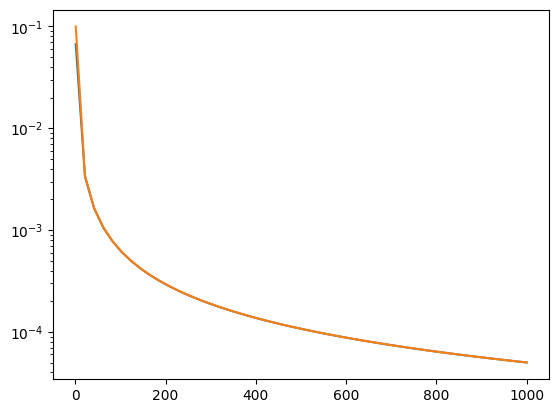
plt.semilogy(Ns, 1/(Ns)**(s-1) - 1/(Ns+1)**(s-1))
plt.semilogy(Ns, (s-1)/Ns**s)

class Levin:
    """Levin trsnformation.

    This is a fairly direct translation of the algorithm given in Numerical Recipes.
    It provide a generator that computes successive terms.
    """
    def __init__(self, get_a, n0=0, nmax=100, type='u', beta=1.0, eps=np.finfo(float).eps):
        """
        Arguments
        ---------
        get_a : function
            Return the nth term of the sum starting at n=0.
        """
        self.get_a = get_a
        self.nmax = nmax
        self.eps = eps
        self.S_n = 0   # Partial sums - unaccelerated
        self.lastval = 0
        self.lasteps = 0.0
        self.n = 0
        self.ncv = 0
        self.cnvgd = False
        self.small = np.finfo(float).tiny * 10.0
        self.big = np.finfo(float).max
        self.numer = []
        self.denom = []
        self.type = type
        self.beta = beta

    def __iter__(self):
        while not self.cnvgd and self.n < self.nmax:
            n = self.n
            a_n = self.get_a(n)
            self.S_n += a_n
            if 'u' == self.type:
                w_n = (self.beta + n) * a_n
            elif 't' == self.type:
                w_n = a_n
            elif 'd' == self.type:
                w_n = self.get_a(n+1)
            elif 'v' == self.type:
                a_n1 = self.get_a(n+1)
                w_n = a_n * a_n1/(a_n - a_n1)

            term = 1.0/(self.beta + n)
            self.denom.append(term/w_n)
            self.numer.append(self.S_n*self.denom[n])
            if n > 0:
                ratio = (self.beta + n - 1) * term
                for j in range(1, n+1):
                    fact = (n - j - self.beta) * term
                    self.numer[n - j] = self.numer[n - j + 1] - fact * self.numer[n - j]
                    self.denom[n - j] = self.denom[n - j + 1] - fact * self.denom[n - j]
                    term *= ratio
            self.n += 1
            val = self.lastval if abs(self.denom[0]) < self.small else self.numer[0]/self.denom[0]
            self.lasteps = abs(val - self.lastval)
            if (self.lasteps <= self.eps):
                self.ncv += 1
            if (self.ncv >= 2):
                self.cnvgd = True
            self.lastval = val
            yield val

def get_a(n, s=2.0):
    return zeta_N(2**(n+1), s=s) - zeta_N(2**n, s=s)


def get_a(n, s=2.0):
    return

l = np.array(list(Levin(get_a, eps=1e-12)))
---------------------------------------------------------------------------
TypeError                                 Traceback (most recent call last)
Cell In[4], line 99
     96 def get_a(n, s=2.0):
     97     return
---> 99 l = np.array(list(Levin(get_a, eps=1e-12)))

Cell In[4], line 59, in Levin.__iter__(self)
     57 n = self.n
     58 a_n = self.get_a(n)
---> 59 self.S_n += a_n
     60 if 'u' == self.type:
     61     w_n = (self.beta + n) * a_n

TypeError: unsupported operand type(s) for +=: 'int' and 'NoneType'
Richardson Extrapolation#
Consider the partial sums \(S_{N}\) and remainders \(E_{N} = S-S_{N}\). As discussed above, the error can be expressed as a polynomial in \(1/N\). More generally, we can write:
In our case, \(k_{n} = n+1\). The idea is to use \(S_{2N}\) to remove the first error term, improving the convergence:
We now have a new approximation \(S^{(1)}_{N}\) that converges more quickly (as \(1/N^{k_1}\)). The idea is to repeat the process on \(S^{(1)}_{N}\) to obtain a new series \(S^{(2)}_{N}\) the converges like \(1/N^{k_2}\), and so on. This gives us a recursive formula:
We can arrange these results in a triangular table: \(s_{n,p} = S^{(n)}_{2^p}\). This defines the following recurrence:
The key points are that, to form the new series, we only need to know \(k_{n}\): we do not need to know the values of \(a_{n}\). We also do not need to know any special values like \(\zeta(2)\) etc. We use the series itself to perform the corrections.
The downside is that we need to double the number of terms at each step, but we can start with \(N=1\), and often this converges very quickly. Another potential problem is that you need to properly characterize \(k_{n}\) for this to work.
def get_S0(N):
    """Naive sum."""
    # To prevent round-off error, we sum from small to large.
    n = np.arange(0, N+1)[::-1]
    return sum(1/(2*n**2 + 1))

def get_S1(N):
    """Improved convergence."""
    n = np.arange(1, N+1)[::-1]
    return 1 + 0.5 + sum(1/(2*n**2 + 1) - 1/(2*n*(n+1)))

def get_S2(N):
    """Improved with zeta(2)."""
    n = np.arange(1, N+1)[::-1]
    zeta2 = np.pi**2/6
    return 1 + zeta2/2 + sum(1/(2*n**2 + 1) - 1/2/n**2)

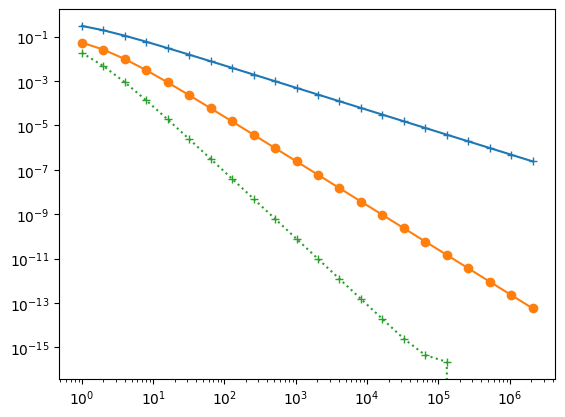
Ns = 2**np.arange(22)
S0s = np.array(list(map(get_S0, Ns)))
S1s = np.array(list(map(get_S1, Ns)))
S2s = np.array(list(map(get_S2, Ns)))
S = (2 + np.sqrt(2)*np.pi / np.tanh(np.pi/np.sqrt(2)))/4

fig, ax = plt.subplots()
ax.loglog(Ns, abs(S-S0s), '-+', label='Naive')
ax.loglog(Ns, abs(S-S1s), '-o', label='Improved')
ax.loglog(Ns, abs(S-S2s), ':+', label='$\zeta(2)$ Improved')
ps = np.arange(11)
ax.loglog(2**ps, [abs(S-s(p, 0)) for p in ps],
          ':.', label="Richardson extrapolation")
ax.legend()
ax.set(xlabel="$N$", ylabel="$S$")
print(S1s[-3:])
---------------------------------------------------------------------------
TypeError                                 Traceback (most recent call last)
Cell In[5], line 29
     27 ax.loglog(Ns, abs(S-S2s), ':+', label='$\zeta(2)$ Improved')
     28 ps = np.arange(11)
---> 29 ax.loglog(2**ps, [abs(S-s(p, 0)) for p in ps],
     30           ':.', label="Richardson extrapolation")
     31 ax.legend()
     32 ax.set(xlabel="$N$", ylabel="$S$")

TypeError: 'float' object is not callable
(f)
\[\begin{gather*} \sum_{n=1}^{\infty}\frac{(-1)^{n}}{n}. \end{gather*}\]